A Dialogue with Polina Stoycheva
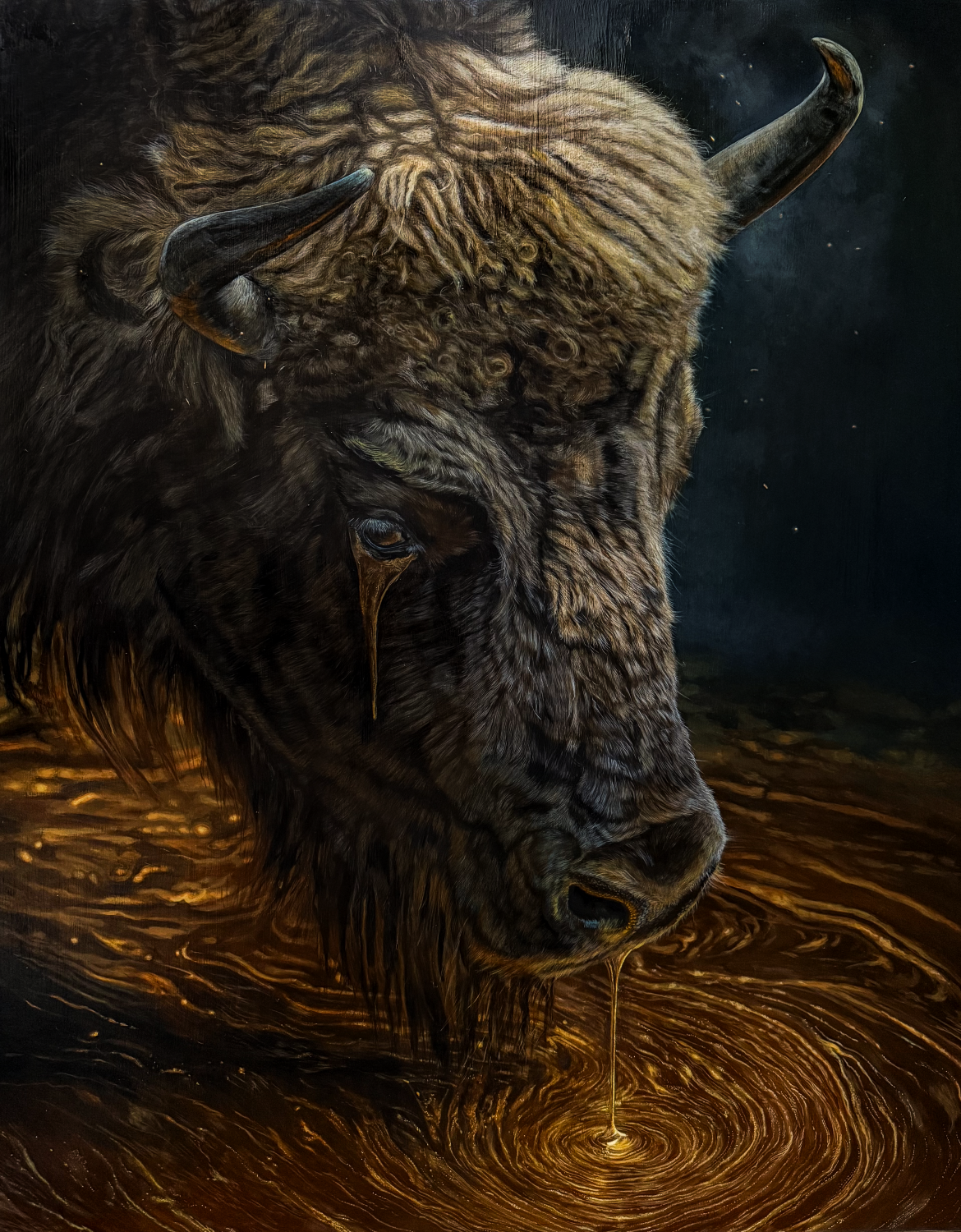
Welcome to DIALOGUES. Today, we step into the silent, powerful world of Polina Stoycheva and her summer exhibition, ‘RAW & GENTLE’. Moving between contemporary realism and deep symbolic metaphors, Polina’s brush captures the wild kingdom not just as it appears, but as it feels. This is an intimate, honest conversation about looking into the eyes of the untamed, the fast rhythm of acrylics, and the beautiful vulnerability of showing art completely frame-free on the digital screen.
I understand why people use the phrase “wild animal,” but I am careful with it because it can easily sound like a label. It can suggest danger, inconvenience, or something that needs to be kept away. In my work, I am more interested in removing those labels than reinforcing them. I do not want the animal to be seen as a pest, a problem in someone’s garden, or a creature defined only by
the word “dangerous.” I want it to be seen as a living presence.
When I look at the animals I paint, whether in real life or through a photograph, I try to look past the automatic human reaction of categorizing them. People often reject what they do not fully understand. When something feels unfamiliar, we quickly turn it into a threat, because that is simpler than learning how to relate to it. I think many animals suffer from that kind of simplification.
What I usually notice in their eyes is not aggression, but alertness, intelligence, sensitivity, and a certain purity. Not purity in a sentimental way, but in the sense that they exist without pretending to be anything else. They are direct. They are present. They do not perform for us.
When I paint, I try not to make the animal more dramatic than it is. I focus on the gaze, the
posture, the tension in the body, the small details that suggest character. The emotion comes through patience and observation rather than exaggeration. I am not trying to humanize the animal. I am trying to make space for the viewer to recognize that there is an individual being there, not just a category or a fear.
There is also some frustration in that process, because a painting is a limited thing. It cannot fix
the way people treat animals. But it can create a pause. It can ask someone to look again, more carefully, and maybe with more respect. That is what I hope to transfer onto the canvas: not only the animal’s appearance, but the quiet dignity I see in it.
Your exhibition is called “RAW & GENTLE”. In your real life, away from the brushes, which side dominates more—the raw, wild instinct or the quiet gentleness? How do these two sides fight or balance each other while you paint?
I think painting is, in many ways, my way of fighting the raw and the wild with brushes. Not fighting it in the sense of denying it, but transforming it into something conscious, something useful, something that does not harm.
Every person has an unpolished, unprocessed, unwanted side. A side that can be reactive, impulsive, selfish, afraid, or even cruel if we allow it to guide our choices. I think it is important to know that side exists. It is dangerous to pretend we are only gentle, only good, only controlled. But knowing that rawness is there does not mean we should surrender to it.
I do not particularly like the version of myself that I could become if I allowed that side to lead me. And I do not like what people can become when they are ruled by fear, anger, ego, or the need to dominate. That is why I see painting as a kind of filter. Through painting, I can experience emotions that might otherwise remain unresolved. I can give shape to something intense without letting it become destructive.
In that sense, the raw and the gentle are not enemies in my work. They need each other. The raw gives the painting honesty, force, and emotional weight. The gentle gives it compassion, restraint, and purpose. Without the raw, the work might become too soft or decorative. Without the gentle, it could become too violent or self-indulgent.
Painting reminds me that gentleness still dominates in me. Even when the subject is powerful, intense, or uncomfortable, the act of painting is still careful. It is still patient. It is still an attempt to understand rather than to destroy. And even if it sounds selfish to say that painting helps me process things, I believe that if I can use this ability to create something meaningful, something that encourages empathy, then it has a purpose beyond myself
Acrylic dries very fast, which means you cannot overthink. Do you ever get scared that a mistake might ruin a piece, or do you love that pressure because it makes you paint directly from the heart?
I do not really feel that kind of pressure when I paint with acrylic. For me, acrylic is not frightening because it dries quickly. In fact, I find it quite forgiving. If something needs to be changed, it can be changed. If something needs to be covered, rebuilt, softened, or sharpened, there is always a way back into the painting.
My process is slow and methodical. I do not usually paint in a rushed or impulsive way, so I do not experience mistakes as dramatic interruptions. I start with intention. I know where I am going emotionally, even if the technical path changes along the way. Because of that, I do not really register “mistakes” as mistakes. They are just part of the process.
Sometimes a mark may not do what I expected it to do, but that does not mean the painting is ruined. It simply means the painting is asking for a different decision. I think that is one of the valuable things about painting: it teaches you not to panic. You learn to observe, adjust, and continue.
So I would not say I paint from pressure. I paint from attention. Acrylic allows me to build, correct, layer, and refine until the image reaches the emotional truth I am looking for. The speed of the material does not force me to lose control. It actually gives me freedom, because I know that nothing is final until I decide it is.
At Vivid Gallery, we show your works completely naked—no frames, no distractions, just your art on a clean screen. How does it feel to see your work so exposed? Does it give you a sense of freedom, or does it make you feel vulnerable?
To me, that is how the work is supposed to be seen at this stage – without a heavy material object holding it or defining it. I understand the power of frames. For some paintings, they are necessary. They can be majestic, ceremonial, almost architectural. They can completely change the way a viewer approaches an artwork.
But for my work right now, I do not feel that need. I do not want anything around the painting to tell the viewer how important it is supposed to be, or how they are supposed to look at it. I want the image to stand on its own.
Seeing the work exposed in that way does not make me uncomfortable. It actually feels honest. There is nothing to hide behind. No ornament, no decoration, no physical weight creating importance around it. The painting is simply there – nothing more, nothing less.
That kind of presentation gives the viewer a very direct encounter with the image. And I think that suits the emotional nature of my work. I am not trying to create distance. I am trying to create a moment of closeness, a quiet confrontation, almost like eye contact. So the absence of a frame does not feel like vulnerability to me. It feels like clarity.
Your paintings often feel like a quiet escape back to nature, away from the noisy world. When someone buys your painting and hangs it in their home, what is the one feeling you want them to feel every single day when they look at it?
I would not want to impose one specific feeling on someone. People buy and live with art for different reasons, and those reasons can be deeply personal. Even if a painting has a very clear idea behind it, far from open interpretation in my own mind, I believe that once it enters someone else’s home, it also enters their life, their memories, their needs, and their emotional world.
What I hope is that each person feels what they need to feel from it. For one person, it might bring calm. For another, strength. For someone else, protection, tenderness, nostalgia, or a sense of being closer to nature. We need different things at different moments in life, and I think a painting can quietly change its meaning depending on what the viewer is carrying that day.
I would like my work to become a kind of presence in the home – not something loud or demanding, but something steady. Something that creates a pause in the middle of everyday life. A reminder that there is still softness, still innocence, still beauty, still something untouched by the noise of the world.
If a person looks at one of my paintings every day and feels a little more connected, a little more grounded, or a little more capable of compassion, then that is enough. I do not need them to feel exactly what I felt while painting it. I only hope the work gives them something real.
- Instagram:@polina.stoycheva
- Website:polinastoycheva.com
- Inquiries & Email: poli.sp@abv.bg